

Tag: Viewer Engagement

  • Video Analytics: Build a Measurement Plan Before You Report

    Video Analytics: Build a Measurement Plan Before You Report

    Your campaign is ready, but nobody has checked whether the embedded video records the actions the report will need. Discovering that gap after launch leaves you with a difficult question: did viewers do nothing, or did the measurement setup miss what they did?

    A video analytics measurement plan addresses that uncertainty before reporting begins. It records what should be collected, where the evidence will appear, how you will test it, and who owns the result. The task here is collection readiness, not interpreting a retention chart or choosing a universal performance benchmark.

    What belongs in a video analytics measurement plan?

    The plan is a working agreement between the marketer, the person responsible for the website or player, and the person preparing reports. It should be specific enough that someone other than its author can check the setup.

    For every required measure, record the video and placement, the action you expect to observe, the collecting system, the documented counting rule, the verification method and the owner. If one of those is unknown, record the gap in your planning document instead of treating a dashboard label as an answer.

    Keep the first version small. A launch report that needs evidence of playback and a particular next step does not automatically need every available interaction. Add a measure when you can name the reporting question it serves.

    Build a tracking inventory by placement and version

    Start with the actual pages where the video will appear. A title alone may be an ambiguous identifier if the same asset is embedded on several pages or replaced with a new edit.

    Fields for a practical video-measurement inventory
    Field What to record
    Placement The page and location of the intended embed, using your team’s internal naming convention.
    Video version A stable reference to the specific edit being measured.
    Required observation The viewer action or viewing measure needed for the report.
    Collection source The system expected to record it and the report or diagnostic view used to verify it.
    Counting rule The documented trigger, unit and treatment of repeated actions, or an explicit unresolved question.
    Acceptance check The controlled action, expected evidence and person responsible for checking it.

    As a hypothetical planning example, a product demonstration appears on a comparison page and a campaign landing page. Keep separate inventory rows if the team needs to report those placements separately. Then establish whether the selected collection system can distinguish them. Naming two rows in a spreadsheet does not create that capability in the software.

    Verify collection coverage before assuming it

    Installing a website analytics tool does not, by itself, establish that your particular player and every in-video action are measured. Check the documented conditions for the collection method you intend to use.

    For example, Google Analytics’ enhanced-measurement documentation scopes its video-engagement events to YouTube embeds with JavaScript API support enabled. That is a specific condition, not a promise of automatic coverage for every embedded player. This example does not establish a Vidzy integration with Google Analytics.

    Ask the implementation owner to identify which collection mechanism is active on each placement. Record any prerequisites and known exclusions in the inventory. Where a required observation has no verified source, either resolve collection before launch or narrow the promised report.

    Run a controlled collection check

    Use an authorized test environment or an agreed test window. Coordinate with the report owner so test activity is documented and handled appropriately; do not assume it can be automatically filtered out.

    1. Record the test context. Note the page, video version, device or browser, time and applicable consent state. Follow the site’s normal consent process rather than bypassing it to make data appear.
    2. Perform one defined action. Use the inventory’s acceptance check. Avoid combining several actions when you need to identify which one produced the evidence.
    3. Inspect the designated source. Confirm that the expected record or measure appears using the system’s supported diagnostic method and documented processing expectations.
    4. Compare the identity and meaning. Check that the evidence belongs to the intended placement and video where those distinctions are supported. A changed total somewhere else is not enough.
    5. Record the outcome. Mark the check passed, failed or inconclusive, with the evidence location and the next owner. Repeat for the other required observations.

    If nothing appears, keep “no activity recorded” separate from “the visitor took no action.” Check the collection prerequisites, reporting delay and test context before drawing a behavioral conclusion. A single successful test is also limited evidence: it validates the tested path, not every possible browser or viewing situation.

    Investigate duplicate collection without inventing a correction

    If one controlled action appears to produce more records than expected, first confirm the documented counting rule. Several records may represent different events rather than duplicates.

    Ask the implementation owner to inspect the collection paths and determine whether the same observation is being sent more than once. Record the finding and repeat the controlled check after any authorized correction. Do not simply divide the reported count to make it match an expectation.

    Two systems may also describe a similar action differently. Keep their names and definitions attached to the values; do not add totals together unless you have established that doing so is meaningful and does not count the same activity twice.

    Agree on the reporting handoff

    Choose the authoritative source for each reported measure before building the summary. The handoff should include the inventory, collection-check results, reporting period, known gaps and any video or page changes that affect comparability.

    Assign one person to resolve collection issues and one to maintain the report. Set a review point based on the campaign’s actual decisions rather than a fixed reporting habit. When an embed or video version changes, identify which acceptance checks need to be repeated.

    Where Vidzy contributes

    Vidzy provides an embeddable player with video analytics, watch-time tracking, CTA click tracking and opt-in tracking. These approved capabilities can inform which observations you investigate for an embedded-video report.

    They do not establish specific counting rules, event payloads, integrations or automatic joins to another system. Verify the definitions and collection behavior your plan requires; this guide does not prescribe Vidzy instrumentation or promise end-to-end attribution.

    Use this launch-readiness handoff

    • Each report question has a named measure and collection source.
    • The intended placements and video versions are recorded.
    • Required collection conditions have been checked.
    • Controlled checks have evidence, outcomes and owners.
    • Unresolved gaps and test activity are disclosed to the report owner.
    • A change to the video or embed triggers the appropriate recheck.

    Complete the inventory for one important video before extending it across the site. Hand it to the person who will prepare the report and ask them to trace each required measure back to verified collection evidence.

  • Where to Put Video on a Landing Page: A Practical Placement Guide

    Where to Put Video on a Landing Page: A Practical Placement Guide

    A landing-page video can be useful and still sit in the wrong place. Put it in the hero before visitors understand the promise, and the play button may ask for attention without giving a reason. Bury a necessary demonstration near the bottom, and people may evaluate the offer without seeing the clearest explanation.

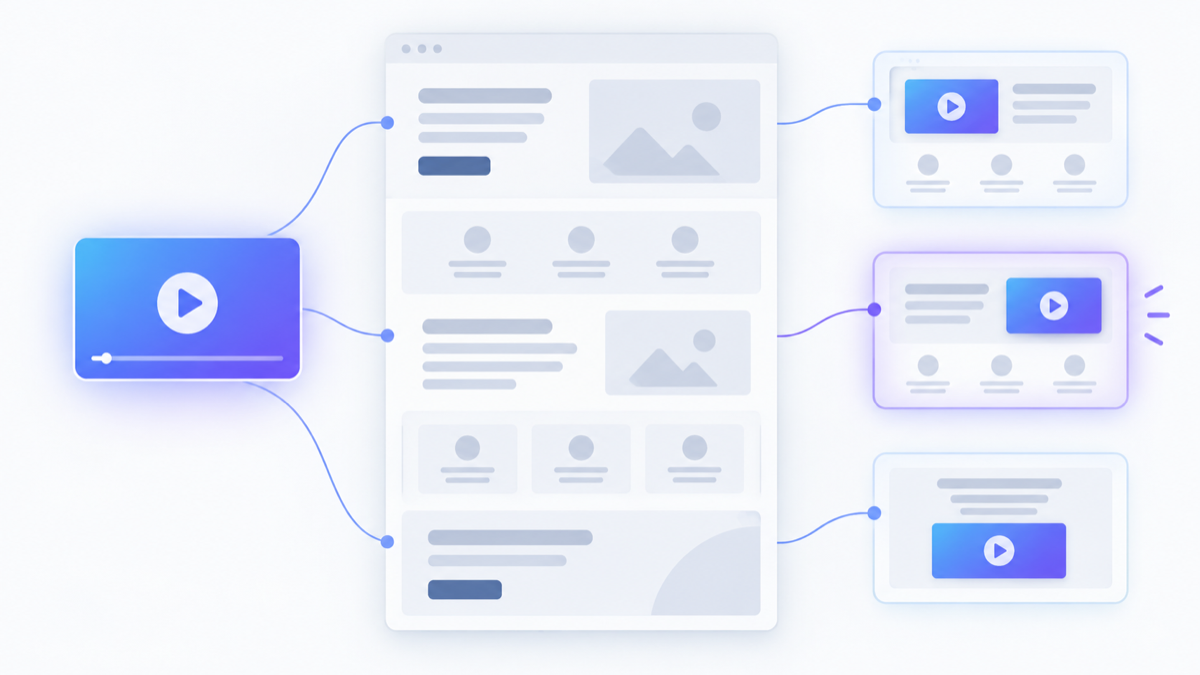
    The answer is not “always above the fold” or “always next to the CTA.” Good landing page video placement follows the page’s information sequence. The video should appear after the visitor has enough context to want it and before the decision it is meant to support.

    This guide gives you a practical way to find that point without relying on a universal layout rule or an invented conversion benchmark.

    Where should you put a video on a landing page?

    Place the video at the earliest point where three conditions are true:

    1. The visitor understands what the page offers and why the video is relevant.
    2. The video contributes something the surrounding copy or images do not communicate as clearly.
    3. A reasonable next step becomes available after the viewer receives that information.

    That point may be the hero for a concise primary explanation. It may be below the opening promise when the headline and supporting copy need to establish context first. It may sit beside a product detail, objection, or CTA when its job is to resolve a specific concern.

    Start with the video’s job, not a template.

    Define the video’s job on this page

    A landing page usually asks a visitor to make one primary decision. The video should remove a particular barrier to that decision rather than repeat the whole page in another format.

    Complete this sentence:

    After watching this video, the intended visitor should be better able to ______.

    Useful answers include:

    • Understand an unfamiliar offer
    • See how a product or process works
    • Compare two approaches
    • Believe that the solution fits a specific situation
    • Resolve a material objection
    • Prepare to take the page’s primary action

    “Feel engaged” is not specific enough. A clear job tells you what must appear before the video, where the player belongs, and which action should follow.

    Use this landing page video placement matrix

    Landing-page video positions and the jobs they can support
    Possible position Strongest reason to use it What should already be clear Main risk to check
    Hero or opening section The video is the fastest useful explanation of the core offer The headline gives viewers a concrete reason to press play The player overwhelms the promise or pushes the primary action out of view
    After the core promise Brief copy creates context before the video adds depth The visitor knows the problem, audience, and expected value The video merely repeats the opening instead of advancing understanding
    Beside a feature or process A demonstration makes a specific mechanism easier to understand The visitor knows why that mechanism matters The section becomes crowded or confusing on smaller screens
    Near proof or an objection The video supplies context that helps evaluate fit or credibility The concern being addressed is explicit The video asks viewers to infer what claim it is meant to support
    Near the primary CTA The video resolves the final question before action The offer and commitment are already understandable The video competes with the CTA or reopens questions the page had settled
    Lower-page deep dive Interested visitors need optional detail without slowing the main argument The page remains persuasive and usable without watching The video is essential but appears too late to influence evaluation

    The matrix does not rank the positions. It connects each location to a job and a failure mode.

    Use hero placement when video carries the opening explanation

    A hero video is appropriate when seeing or hearing the explanation is central to understanding the offer. A short product overview, a concise demonstration, or a clear statement from a trusted expert may earn that prominence.

    The surrounding section still needs to work before anyone presses play. Give the visitor a specific headline, a short explanation, and a visible primary action when that action is appropriate. The thumbnail or poster should signal what the viewer will learn rather than act as decoration.

    Review the layout without playing the video. If the offer becomes vague, the video may be carrying information that should also appear in the page copy. If the player dominates every other element, reduce its visual weight or move it after the opening promise.

    Let the core promise come first when context creates interest

    Some visitors need to recognize the problem or understand the result before a video feels worth their time. In that case, place the opening message first and use the video as the next layer of explanation.

    This works well when the video:

    • Shows how the promised outcome is achieved
    • Demonstrates a workflow introduced by the opening copy
    • Explains a concept that would make the hero too dense
    • Answers the first substantial question raised by the promise

    Do not add a generic heading such as “Watch our video.” Introduce the actual value: what question will the video answer, and why is that answer relevant now?

    Place demonstrations beside the claim they explain

    A demonstration is easiest to evaluate when it appears close to the feature, process, or outcome it clarifies. Distance creates interpretation work. The visitor has to remember a claim from earlier or guess which part of the page the video supports.

    Keep the section focused. Pair the video with a concise explanation rather than a second full pitch. On a narrow screen, decide whether the explanation or the player should come first. Preserve that order deliberately instead of accepting whatever stacking order the desktop layout produces.

    If several page sections each appear to need a video, question whether every clip is necessary. Multiple players can fragment attention and create additional loading work. One strong demonstration with clear surrounding context may serve the page better than several overlapping clips.

    Connect placement with the page’s next action

    Video placement and CTA design are related, but they are not the same decision. Placement determines when the visitor encounters the explanation. The CTA determines what the visitor can do after it becomes useful.

    Ask:

    1. What should a viewer understand before seeing the action?
    2. Does the action remain visible or easy to find after playback?
    3. Does its wording continue the video’s promise?
    4. Can a visitor who does not watch still understand the action?

    A CTA can appear around the player or, when the player supports it, within the viewing experience. Avoid presenting several equally prominent choices at once. The video should reduce uncertainty before the next step, not create a new navigation menu.

    Make the page useful without requiring playback

    Some visitors will not press play. They may be scanning, returning to confirm one detail, browsing in a setting where audio is inconvenient, or using an interaction method that makes the experience different from the one you designed.

    Keep the essential offer, major conditions, and primary action available in the page itself. Use video to explain, demonstrate, or add context. Do not hide information a visitor must know solely inside an optional recording.

    For prerecorded synchronized media with audio, accessibility requirements also matter. W3C’s explanation of WCAG Success Criterion 1.2.2 says captions are provided for prerecorded audio content in synchronized media, except when the media is clearly identified as an alternative that presents no more information than existing text. Review the exact scope in the official W3C guidance on prerecorded captions.

    Caption availability and other media-accessibility needs depend on the video, player, implementation, and applicable requirements. Verify them before launch rather than assuming the embed handles them automatically.

    Check the mobile sequence separately

    Desktop proximity does not guarantee a clear mobile experience. Two side-by-side elements may become a long vertical sequence. A video placed “next to” an objection can end up several screens away from it after headings, copy, and controls stack.

    On a real narrow viewport, check:

    • Whether the headline and video still appear in a sensible order
    • Whether the player has a stable, usable size
    • Whether the primary CTA remains easy to find after playback
    • Whether surrounding copy is separated clearly from player controls
    • Whether the page remains understandable without playing the video

    Treat mobile ordering as editorial structure, not a final cosmetic adjustment.

    Match loading behavior to the placement

    An offscreen video does not necessarily need to load with the opening section. web.dev documents that lazy-loading an offscreen iframe can defer its loading until the visitor scrolls near it, reducing initial resource use. See the implementation context in its guide to lazy-loading offscreen iframes.

    That does not mean every video should be lazy-loaded. A primary video in the opening viewport, a poster that contributes to the page’s initial rendering, and an offscreen supporting embed have different loading considerations. Test the actual page and implementation rather than applying one attribute mechanically.

    Reserve stable space for the player so the surrounding layout does not jump when it appears. Check the page on a slower connection and on the devices that matter to your audience. Placement is only successful if the intended visitor can encounter and use the video without the page becoming harder to navigate.

    Measure placement as part of the whole page

    A placement test should begin with a decision. For example: “Should the demonstration appear immediately after the promise or beside the feature explanation?” Define what you expect each position to change before moving the player.

    Review evidence in layers:

    • Opportunity: Did visitors reach the section and have a reasonable chance to notice the player?
    • Viewing: Did playback and attention behavior change?
    • Action: Did use of the relevant CTA change?
    • Outcome: Did the wider page journey produce its intended result?

    A change in one layer does not prove the cause. Moving a video also changes the visual hierarchy, nearby copy, scroll position, and relationship with the CTA. Record those differences, keep the page version and traffic context clear, and avoid changing several major elements when you need to learn from one placement decision.

    How Vidzy can support the planned experience

    Vidzy is an embeddable, conversion-focused video player with player skins and play-button style and color customization. Those approved controls can help the player feel intentional within the page design without determining where it belongs.

    Vidzy also supports timed, clickable calls to action that can send viewers to a chosen destination. Its approved analytics capabilities include watch-time tracking, drop-off analysis, CTA click tracking, and replay tracking. These signals can support a placement review, but they do not diagnose why a visitor acted or prove that placement caused a business outcome.

    Choose the location and page sequence first. Then evaluate whether the player customization, action, and measurement capabilities fit the experience you planned.

    Landing page video placement checklist

    1. State the page’s primary visitor decision.
    2. Give the video one page-level job.
    3. Write what the visitor must understand before pressing play.
    4. Write what becomes reasonable immediately after watching.
    5. Choose the earliest position where both statements make sense.
    6. Confirm the page still communicates its essential offer without playback.
    7. Check captions and other applicable media-accessibility needs.
    8. Review the stacking order and CTA visibility on a narrow viewport.
    9. Test the actual embed’s loading and layout behavior.
    10. Define opportunity, viewing, action, and outcome evidence before launch.

    Landing page video placement FAQs

    Should a landing-page video always be above the fold?

    No. Above-the-fold placement is useful when video is central to the opening explanation and the surrounding section provides enough context to justify playback. If copy must establish the problem or promise first, a lower position may create a clearer sequence.

    Should the CTA be inside the video or on the page?

    Use the location that makes the next step clear and accessible in the intended journey. A page CTA remains available to people who do not play the video. An in-video CTA can connect an action to a relevant moment. Some pages may use both, but they should represent a coherent primary action rather than competing choices.

    How many videos should a landing page include?

    There is no universal number. Add a video only when it performs a distinct job that the page needs. If multiple clips repeat the same explanation or divide attention between several paths, consolidate them or keep the strongest one.

    Open the landing page and complete two sentences: “Before this video, the visitor needs to understand…” and “After this video, the visitor should be ready to…” Place the player where those statements meet, then review Vidzy’s approved player capabilities if you need a more intentional embedded experience.