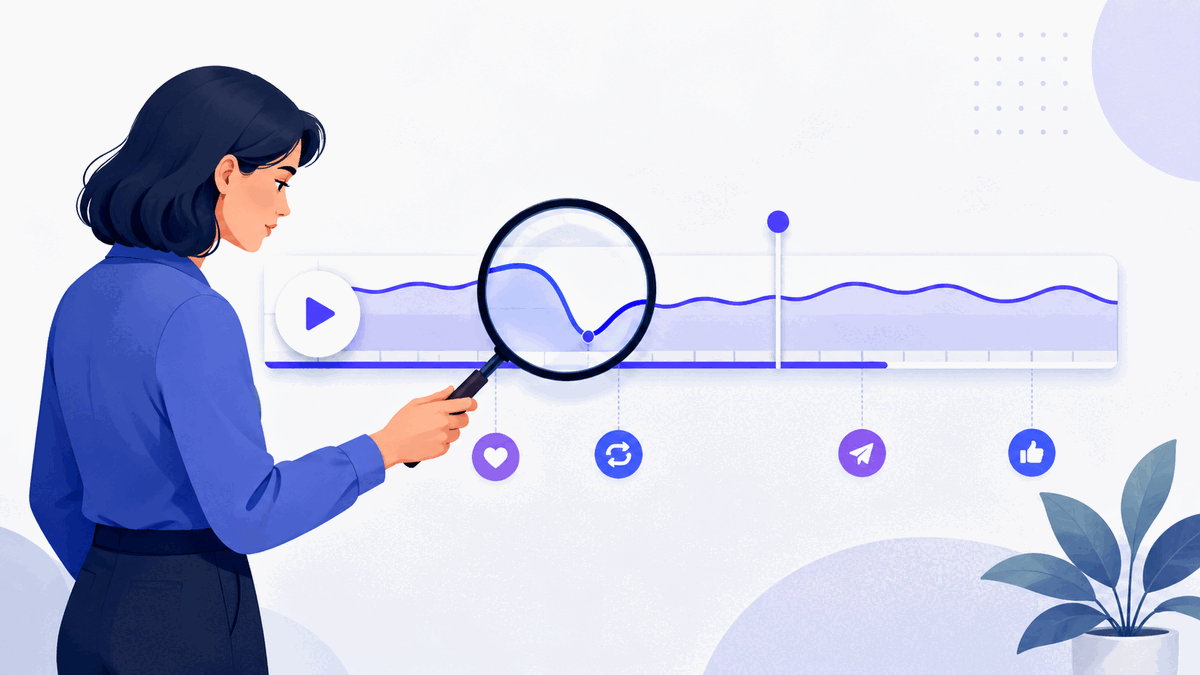

Tag: Video Analytics

  • Video Analytics: Build a Measurement Plan Before You Report

    Video Analytics: Build a Measurement Plan Before You Report

    Your campaign is ready, but nobody has checked whether the embedded video records the actions the report will need. Discovering that gap after launch leaves you with a difficult question: did viewers do nothing, or did the measurement setup miss what they did?

    A video analytics measurement plan addresses that uncertainty before reporting begins. It records what should be collected, where the evidence will appear, how you will test it, and who owns the result. The task here is collection readiness, not interpreting a retention chart or choosing a universal performance benchmark.

    What belongs in a video analytics measurement plan?

    The plan is a working agreement between the marketer, the person responsible for the website or player, and the person preparing reports. It should be specific enough that someone other than its author can check the setup.

    For every required measure, record the video and placement, the action you expect to observe, the collecting system, the documented counting rule, the verification method and the owner. If one of those is unknown, record the gap in your planning document instead of treating a dashboard label as an answer.

    Keep the first version small. A launch report that needs evidence of playback and a particular next step does not automatically need every available interaction. Add a measure when you can name the reporting question it serves.

    Build a tracking inventory by placement and version

    Start with the actual pages where the video will appear. A title alone may be an ambiguous identifier if the same asset is embedded on several pages or replaced with a new edit.

    Fields for a practical video-measurement inventory
    Field What to record
    Placement The page and location of the intended embed, using your team’s internal naming convention.
    Video version A stable reference to the specific edit being measured.
    Required observation The viewer action or viewing measure needed for the report.
    Collection source The system expected to record it and the report or diagnostic view used to verify it.
    Counting rule The documented trigger, unit and treatment of repeated actions, or an explicit unresolved question.
    Acceptance check The controlled action, expected evidence and person responsible for checking it.

    As a hypothetical planning example, a product demonstration appears on a comparison page and a campaign landing page. Keep separate inventory rows if the team needs to report those placements separately. Then establish whether the selected collection system can distinguish them. Naming two rows in a spreadsheet does not create that capability in the software.

    Verify collection coverage before assuming it

    Installing a website analytics tool does not, by itself, establish that your particular player and every in-video action are measured. Check the documented conditions for the collection method you intend to use.

    For example, Google Analytics’ enhanced-measurement documentation scopes its video-engagement events to YouTube embeds with JavaScript API support enabled. That is a specific condition, not a promise of automatic coverage for every embedded player. This example does not establish a Vidzy integration with Google Analytics.

    Ask the implementation owner to identify which collection mechanism is active on each placement. Record any prerequisites and known exclusions in the inventory. Where a required observation has no verified source, either resolve collection before launch or narrow the promised report.

    Run a controlled collection check

    Use an authorized test environment or an agreed test window. Coordinate with the report owner so test activity is documented and handled appropriately; do not assume it can be automatically filtered out.

    1. Record the test context. Note the page, video version, device or browser, time and applicable consent state. Follow the site’s normal consent process rather than bypassing it to make data appear.
    2. Perform one defined action. Use the inventory’s acceptance check. Avoid combining several actions when you need to identify which one produced the evidence.
    3. Inspect the designated source. Confirm that the expected record or measure appears using the system’s supported diagnostic method and documented processing expectations.
    4. Compare the identity and meaning. Check that the evidence belongs to the intended placement and video where those distinctions are supported. A changed total somewhere else is not enough.
    5. Record the outcome. Mark the check passed, failed or inconclusive, with the evidence location and the next owner. Repeat for the other required observations.

    If nothing appears, keep “no activity recorded” separate from “the visitor took no action.” Check the collection prerequisites, reporting delay and test context before drawing a behavioral conclusion. A single successful test is also limited evidence: it validates the tested path, not every possible browser or viewing situation.

    Investigate duplicate collection without inventing a correction

    If one controlled action appears to produce more records than expected, first confirm the documented counting rule. Several records may represent different events rather than duplicates.

    Ask the implementation owner to inspect the collection paths and determine whether the same observation is being sent more than once. Record the finding and repeat the controlled check after any authorized correction. Do not simply divide the reported count to make it match an expectation.

    Two systems may also describe a similar action differently. Keep their names and definitions attached to the values; do not add totals together unless you have established that doing so is meaningful and does not count the same activity twice.

    Agree on the reporting handoff

    Choose the authoritative source for each reported measure before building the summary. The handoff should include the inventory, collection-check results, reporting period, known gaps and any video or page changes that affect comparability.

    Assign one person to resolve collection issues and one to maintain the report. Set a review point based on the campaign’s actual decisions rather than a fixed reporting habit. When an embed or video version changes, identify which acceptance checks need to be repeated.

    Where Vidzy contributes

    Vidzy provides an embeddable player with video analytics, watch-time tracking, CTA click tracking and opt-in tracking. These approved capabilities can inform which observations you investigate for an embedded-video report.

    They do not establish specific counting rules, event payloads, integrations or automatic joins to another system. Verify the definitions and collection behavior your plan requires; this guide does not prescribe Vidzy instrumentation or promise end-to-end attribution.

    Use this launch-readiness handoff

    • Each report question has a named measure and collection source.
    • The intended placements and video versions are recorded.
    • Required collection conditions have been checked.
    • Controlled checks have evidence, outcomes and owners.
    • Unresolved gaps and test activity are disclosed to the report owner.
    • A change to the video or embed triggers the appropriate recheck.

    Complete the inventory for one important video before extending it across the site. Hand it to the person who will prepare the report and ask them to trace each required measure back to verified collection evidence.

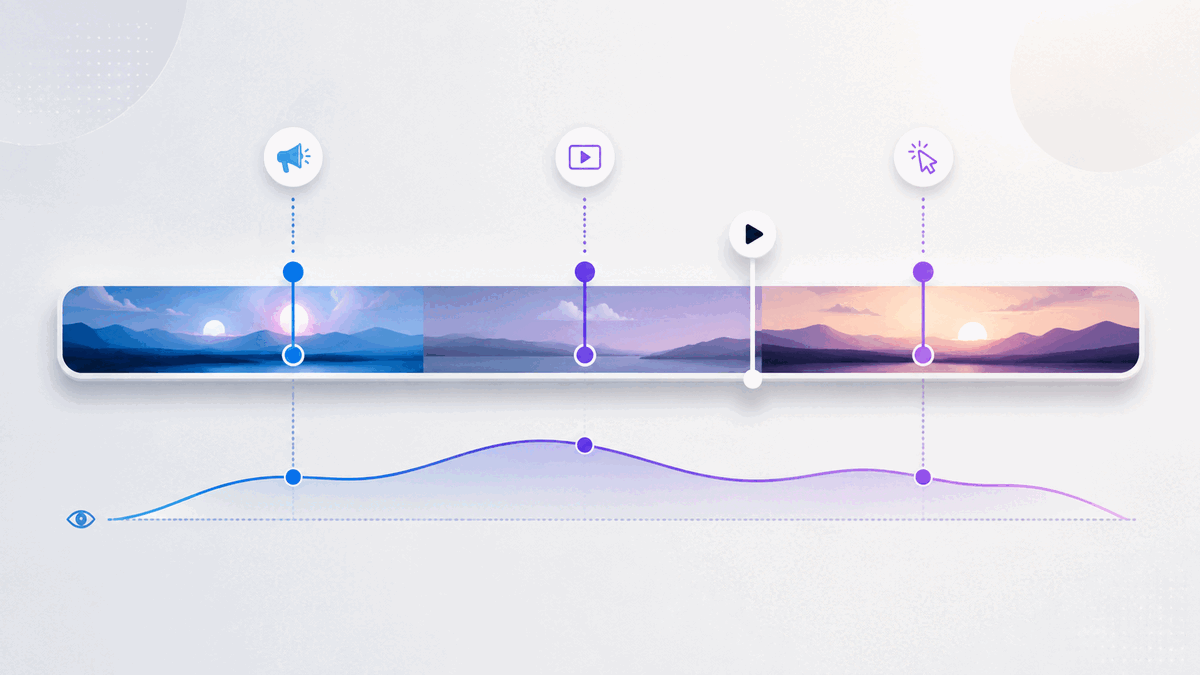
  • Video Heatmap: How to Read the Legend and Compare Reports

    Video Heatmap: How to Read the Legend and Compare Reports

    A video heatmap can look self-explanatory: some sections have more color than others. But a colored section does not explain itself. Before using the report in a presentation, you need to know what each mark represents, whose playback it includes and how the legend works.

    This guide helps you decode that report. The goal is to describe it accurately and recognize which other reports can be compared with it, before drawing conclusions about the video.

    What does a video heatmap represent?

    In playback analytics, a video heatmap represents activity along a video’s timeline. Read its documented definition to establish the exact activity being represented. Do not assume that the term means a map of where someone’s eyes looked or where their pointer moved across the image.

    Start with two questions: what does one row or mark stand for, and what changes its appearance? The answer should come from the report’s help text or documentation, not from the colors alone.

    Identify the reporting unit first

    A single-session record and an audience-wide summary answer different questions. The first can describe a particular playback journey; the second combines activity. Treating one session as the audience’s typical experience would require evidence beyond that one record.

    For a concrete, platform-specific example, Wistia describes a heatmap as a representation of a single viewing or listening session. Its glossary describes the engagement graph, in contrast, as an aggregate view. Those are Wistia’s report definitions, not definitions of Vidzy’s heatmaps.

    When opening an unfamiliar report, identify whether it describes a playback session, a viewer or a combined population. Do not assume that a session equals a unique person, or that an anonymous record identifies a contact. If the unit is unclear, leave it unresolved in your notes instead of choosing the interpretation that fits your story.

    Read the legend before naming a pattern

    Colors need an explicit key. Avoid labeling a warm-colored section “good engagement” or a pale section “lost interest” unless those words accurately describe the documented measure. A legend describes an encoding, not a judgment about content quality.

    Wistia’s official heatmap guide provides a useful example: white denotes unplayed portions, green denotes one play and yellow denotes two plays, with warmer colors for further repeats. It also explains that the percentage at the end counts repeatedly played portions only once. A colored timeline and its summary can therefore describe different aspects of the same session. Do not apply this legend to another product without checking its documentation.

    Save the legend with any report excerpt you share. Without it, a colleague may mistake repeat playback for a larger audience or interpret a change of color as a conversion signal.

    Separate coverage from repeated playback

    Consider a hypothetical video split into ten equal sections. A session plays four different sections, then plays one of those sections again. Under a measure that counts distinct sections reached, coverage is four out of ten. Under a measure that counts all complete section plays, the total is five.

    Neither number contradicts the other. They count different things. This is an illustrative accounting example, not a Vidzy calculation, a benchmark or a real customer result.

    Before explaining a summary next to a heatmap, establish whether it counts distinct portions, accumulated playback time or something else. Also check how partial plays are handled. A summary label such as “engagement” is not enough to reconstruct its formula.

    Check compatibility before comparing reports

    Two reports placed side by side can appear comparable simply because both use a timeline. Use the following checks before describing one as higher, lower or improved.

    Checks for comparing two video reports without mixing definitions
    Check What must be clear
    Reporting unit Whether both reports describe sessions, viewers or aggregates; a single session is not interchangeable with an audience summary.
    Measure and scale Whether the marks encode counts, time or percentages, and whether color thresholds stay fixed between reports.
    Timeline Whether positions refer to elapsed time or relative progress, and whether the video versions contain the same material at that position.
    Grouping Whether a mark represents a moment or a wider interval; an interval does not identify an exact second.
    Included activity Whether the reports cover the same relevant audience and period, and how repeats enter the calculation.

    For example, if a revised introduction moves a demonstration later, the same timestamp no longer points to the same content. Align the relevant sections before comparing them. Similarly, if each chart chooses its own color thresholds, the darkest tile in one report need not represent the same quantity as the darkest tile in another.

    If these details are unavailable, describe each report separately. A qualified description is more useful than a precise-looking comparison built on incompatible measures.

    Attach a short reading card to the report

    Before sharing a heatmap, add a plain-language note containing:

    • Report: the platform and report name.
    • Unit: what one record represents.
    • Legend: what color, height or another visual mark encodes.
    • Timeline: the video version and how positions are grouped.
    • Summary: what any adjacent total or percentage counts.
    • Comparison limit: which differences prevent a direct comparison.

    Use explicit wording such as “This report represents one playback session; its colors show the documented repeat categories.” Use that sentence only when both statements are verified. Otherwise, note the missing definition and request it from the report owner.

    Using heatmaps with Vidzy

    Vidzy is an embeddable video player with video analytics and heatmaps. Those capabilities do not establish a particular legend, aggregation method or formula. This article does not assign the Wistia example or the hypothetical section-counting method to Vidzy.

    Start with one report you need to explain and complete its reading card. Resolve the missing definitions before comparing it with another report or forwarding a cropped chart to your team.

  • Video CTA Timing: How to Choose the Right Moment

    Video CTA Timing: How to Choose the Right Moment

    A video call to action can be clear, relevant, and persuasive yet still underperform because it appears at the wrong moment. Show it before the viewer understands the value and the request feels premature. Wait until the final frame and interested viewers may never see it.

    There is no universal timestamp that solves this problem. The right video CTA timing depends on what you are asking, what the viewer already knows, and when the video earns enough trust to make the next step feel reasonable.

    This guide gives you a practical way to choose that moment without relying on invented benchmarks or guesswork.

    What is the best time to show a video CTA?

    The best time to show a video CTA is the earliest point at which an interested viewer has enough context to understand the offer and enough motivation to take the next step. That point may be near the beginning for a familiar offer, midway through a demonstration after the key benefit becomes clear, or at the end when the full argument matters.

    Use these four questions to find it:

    1. What exact action should the viewer take?
    2. What must the viewer know or believe before that action makes sense?
    3. At what moment does the video provide that context?
    4. What does viewer behavior show after the CTA goes live?

    This turns CTA placement into an editorial decision you can test and refine, rather than a rule based only on video length.

    Start with the action, not the timestamp

    Before choosing when a CTA should appear, define what it should accomplish. “Get more conversions” is too broad. Name one observable next step:

    • View a product page
    • Book a consultation
    • Start a trial
    • Download a resource
    • Register for an event
    • Join an email list

    The size of the request affects its timing. A low-commitment action such as viewing a related resource may need little preparation. A higher-commitment action such as booking a call usually needs more context: who the offer is for, which problem it addresses, and what happens after the click.

    Write the intended action at the top of your video outline. If you cannot express it in one sentence, the CTA is not ready to time.

    Identify the minimum context the viewer needs

    A CTA becomes timely when the viewer has the information needed to evaluate it. That does not always mean watching the entire video. It means reaching the point where the request follows logically from the content.

    For a product demo, that point might come just after the viewer sees the core workflow. For an educational video, it might follow the first useful lesson, when a related template or deeper guide becomes relevant. For a sales video, the CTA may need to wait until the problem, proposed solution, and important objections have been addressed.

    List the minimum context required before the ask:

    • The problem is recognizable.
    • The promised next step is relevant to that problem.
    • The viewer knows what will happen after clicking.
    • The request is proportionate to the value delivered so far.

    The CTA should generally appear after these conditions are met, not after an arbitrary percentage of the runtime.

    Map the moments that matter in the video

    Review the video as a sequence of decisions rather than one continuous block. Mark the moments where the viewer learns something important, sees evidence, understands the mechanism, or receives a complete answer.

    How key video moments can inform CTA timing decisions
    Video moment What changes for the viewer CTA implication
    Problem recognition The viewer recognizes that the subject applies to them. A light next step may be relevant, but a large request can still feel early.
    First useful insight The video has delivered value and established relevance. A resource or low-commitment action may fit here.
    Mechanism or demonstration The viewer understands how the proposed solution works. A product-focused CTA may now have sufficient context.
    Objection resolved A likely reason for hesitation has been addressed. A higher-commitment CTA may become more reasonable.
    Summary or conclusion The complete argument or lesson is clear. A direct next step can close the loop.

    This map gives you candidate CTA moments. Choose the earliest candidate that supports the specific action you defined.

    When early, middle, and end CTAs make sense

    Use an early CTA when intent is already high

    An early CTA can work when viewers arrive with clear intent and the offer needs little explanation. Someone watching a short feature walkthrough from a product page may already know the product and simply need a route to the relevant next step.

    Keep an early CTA proportional to the context available. “See the full example” makes a smaller leap than “Book a strategy call” in the opening seconds.

    Use a mid-video CTA after a meaningful payoff

    A middle placement is useful when the video delivers an important insight or demonstration before its conclusion. The CTA can appear immediately after that payoff, while the next step is relevant to what the viewer just learned.

    Avoid interrupting a sentence, demonstration, or unresolved idea. A natural transition is usually a better trigger than the mathematical midpoint.

    Use an end CTA when the complete argument matters

    An end CTA fits stories, tutorials, and sales messages that depend on a sequence. The viewer receives the full explanation before being asked to act.

    The tradeoff is reach: some viewers will leave before the conclusion. That does not automatically make the placement wrong. If the people who remain are the only viewers with enough context for the offer, the end may still be the most coherent moment.

    Match the CTA type to the commitment level

    Not every prompt inside a video serves the same purpose. A clickable CTA sends the viewer to another destination. A lead gate or email opt-in asks the viewer to exchange information for access, continuity, or an additional resource. These actions create different levels of friction and should not be timed as if they were interchangeable.

    Use a clickable CTA when the natural next step exists elsewhere, such as a product page, booking page, or related guide. Use a lead-capture request when the exchange is explicit and the value of continuing is clear. In either case, the viewer should understand what they receive and what happens next.

    If you present more than one action, give each a distinct role. Repeating the same high-commitment request at every transition can weaken the experience instead of strengthening it.

    Write CTA copy that explains the destination

    Timing cannot rescue an unclear CTA. Labels such as “Click here” or “Learn more” make the viewer infer both the destination and the benefit. Prefer specific language:

    • See the complete workflow
    • Download the campaign checklist
    • Compare the available options
    • Book a product walkthrough

    This is also an accessibility consideration. The W3C’s WCAG 2.2 guidance says a link’s purpose should be understandable from its text alone or from its programmatically determined context. Its guidance for interactive components also calls for names and roles that assistive technology can determine. Review W3C guidance on link purpose and W3C guidance on component names and roles when implementing the interaction.

    As an editorial check, read the CTA label without the surrounding video. If the next step is still understandable, the copy is doing useful work.

    Measure and revise CTA timing responsibly

    Your first placement is a hypothesis. Viewer behavior can help you decide whether to keep it or move it.

    Start with three questions:

    1. Do viewers reach the CTA? Compare its timestamp with watch-time and drop-off patterns.
    2. Do CTA clicks occur? CTA click data shows whether the prompt generates recorded clicks. Interpret it alongside how many viewers appear to reach that part of the video, without treating the comparison as a precise view-to-click rate unless your measurement setup supports it.
    3. Does the destination complete the journey? Evaluate the result on the destination page with the appropriate measurement system rather than treating a click as the final outcome.

    Interpret the sequence carefully. If few viewers reach the CTA, moving it earlier is one possible response, but it is not the only one. The opening may be attracting the wrong audience, the video may take too long to deliver value, or the CTA may depend on information that arrives late. Editing the video can be more useful than moving the button.

    If viewers reach the CTA but rarely click, inspect the offer, label, visual prominence, and surrounding message before blaming timing. If clicks occur but the destination does not produce the intended next step, review the match between the CTA promise and the landing page.

    Change one major element at a time when practical. A simultaneous change to the video, CTA copy, destination, design, and timing may improve results, but it will not tell you which change mattered.

    Common video CTA timing mistakes

    Choosing a percentage instead of a persuasion moment

    Placing every CTA halfway through every video is consistent, but consistency is not the same as relevance. The meaningful payoff could happen much earlier or later.

    Waiting for the end by default

    The conclusion is a logical location, not a mandatory one. If the viewer receives enough context earlier, an earlier opportunity to act may be useful.

    Asking before delivering value

    A prompt that appears before the viewer understands the subject can feel like a toll. Earn the request with relevance, useful information, or a clear preview of what comes next.

    Treating every drop-off as a timing problem

    Drop-off can identify where attention changes, but it does not explain why. Review the content around that moment before drawing a conclusion.

    Optimizing for clicks alone

    A compelling label can earn clicks that the destination cannot satisfy. Judge the CTA as one part of a complete path, from the video’s promise to the page after the click.

    A practical video CTA timing worksheet

    Use this short worksheet before configuring a CTA:

    1. Primary viewer: Who is this video for?
    2. Single next step: What should that viewer do?
    3. Commitment level: Is the request low, medium, or high commitment?
    4. Required context: What must the viewer understand first?
    5. Context-complete timestamp: When has the video supplied it?
    6. Natural transition: Where can the CTA appear without interrupting an idea?
    7. CTA label: Does the text explain the destination or outcome?
    8. Reach check: What do watch-time and drop-off patterns show around that moment?
    9. Action check: What do CTA clicks show among viewers who reach it?
    10. Next revision: Which single major variable will you change if needed?

    Document the reason for the original timestamp. That note prevents future decisions from becoming a cycle of unexplained adjustments.

    How Vidzy supports a CTA-timing workflow

    Vidzy is an embeddable, conversion-focused video player with timed calls to action and clickable CTA links. Its video analytics include watch time and drop-off data, and it can track CTA clicks. Vidzy also supports timed email opt-ins and lead gates when lead capture is the appropriate next step.

    Those capabilities provide the placement and observation tools for this workflow. They do not replace the editorial decision. You still need to define the right action, identify when the video earns it, and evaluate the complete journey after the click.

    Frequently asked questions about video CTA timing

    Should a video CTA appear at the beginning or the end?

    It depends on how much context the action requires. Use an early CTA when intent is already high and the next step is easy to understand. Use an end CTA when the viewer needs the complete lesson, story, or argument before acting.

    Can a CTA appear in the middle of a video?

    Yes. A mid-video CTA can fit immediately after a useful insight, demonstration, or resolved objection. Choose a natural transition instead of interrupting an unfinished idea.

    Should I move a CTA earlier when viewers drop off before it?

    Consider it, but first inspect why viewers may be leaving. The content may delay its main value, attract the wrong audience, or lose clarity. Moving the CTA earlier helps only if viewers have enough context to respond to it.

    How do I know whether CTA timing is working?

    Review whether viewers reach the timestamp, whether those viewers click, and whether the destination fulfills the promised next step. Watch time, drop-off patterns, and CTA clicks answer different parts of that sequence.

    Choose the moment the message earns

    Effective video CTA timing is not about finding a magic percentage. It is about matching the request to the viewer’s readiness. Define one next step, identify the context it requires, place the CTA after the video provides that context, and use behavioral data to refine the decision.

    That approach gives the CTA a job, the timestamp a reason, and your next revision a useful starting point.